
Amazing New Face Blog

How Long Does a PDO Thread Lift Really Last?
Hits: 157
A PDO thread lift can create a fresher, slightly lifted appearance without the incisions or recovery associated with facial surgery. Before booking, however, most people want one clear answer: How long will the result actually last?
For many suitable patients, the most noticeable lifting effect lasts approximately 6 to 12 months. Some people may continue to see improvement for 12 to 18 months, while others notice the effect softening sooner. Facial anatomy, skin quality, tissue weight, treatment area, thread design, placement, and individual healing all influence the timeline.
PDO gradually breaks down inside the body, while the healing response around the treatment area may temporarily support firmer-looking skin. Collagen stimulation, however, should not be confused with permanent lifting.
Quick Answer: PDO Thread Lift Timeline
A practical timeline is:
- First 2 weeks: Swelling, tightness, bruising, or temporary unevenness begins to settle.
- 1 to 3 months: The result usually looks more natural, while tissue remodeling continues.
- 3 to 6 months: The PDO material is gradually breaking down, but the lift may remain visible.
- 6 to 12 months: Many patients still see improvement, although it may become softer.
- 12 to 18 months: Selected patients may retain some benefit, but this is possible, not guaranteed.
A large 2025 multicentre review reported an average thread-lift effect of about 6 to 12 months and noted that PDO threads commonly degrade within roughly 6 to 8 months. Another 2025 review found that absorbable thread lifts can provide an immediate result in appropriate patients, while emphasizing that long-term efficacy data remain limited.
Why Do Online Answers Vary?
You may see one clinic promising six months and another claiming two years. The confusion usually comes from mixing together three timelines:
- How long the PDO material remains in the tissue
- What a long collagen and tissue remodeling continue
- How long the visible lifting effect remains noticeable
These timelines overlap, but they are not identical. A thread may begin losing mechanical strength before it is fully absorbed. Meanwhile, supportive tissue may form around the treatment pathway. This can help the skin look firmer after the thread starts dissolving, but it does not hold the face permanently in a new position.
A trustworthy consultation should therefore provide a realistic range based on your face, not a guaranteed expiration date.
What Is a PDO Thread Lift?
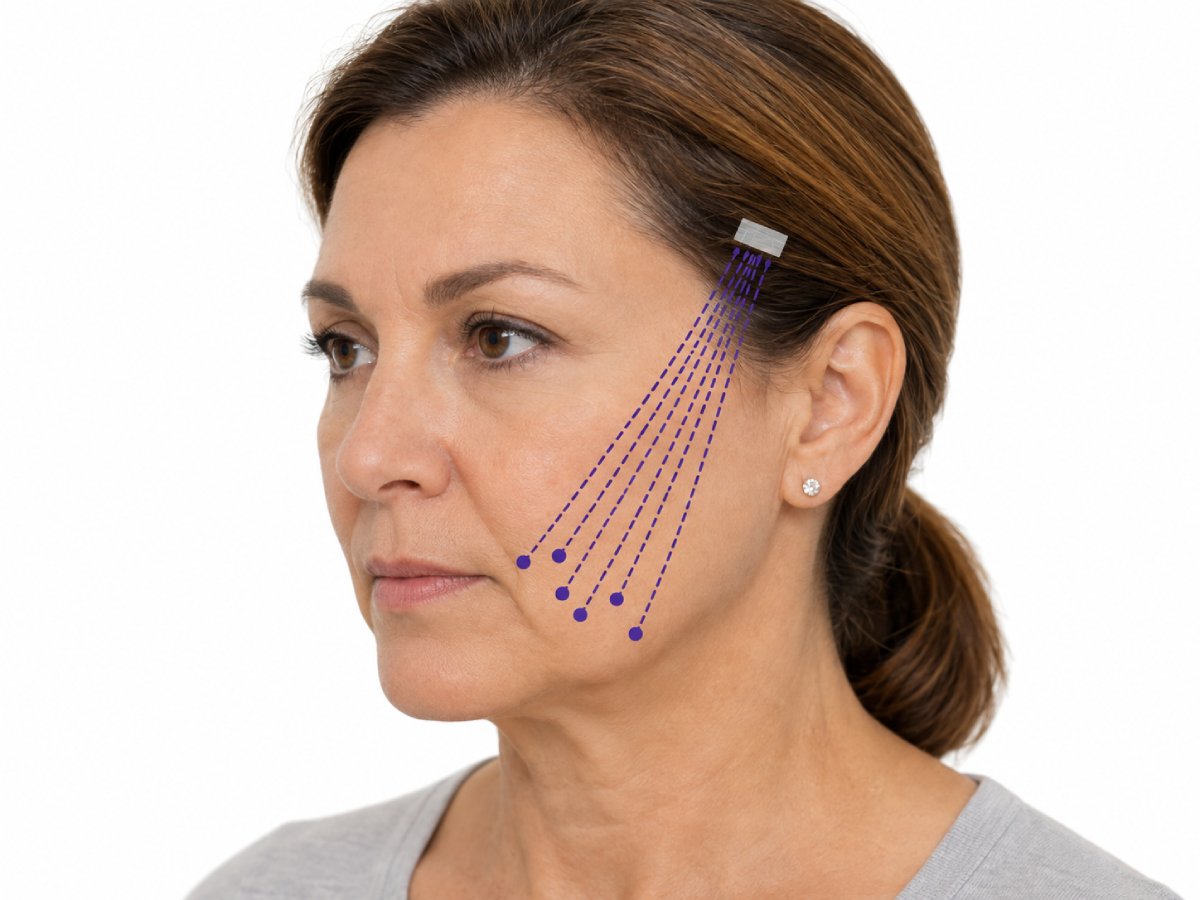
PDO stands for polydioxanone, a biodegradable material also used in absorbable medical sutures. During a cosmetic thread lift, specialized threads are placed beneath the skin to support and reposition selected areas of soft tissue.
Barbed or cog threads are designed to grip tissue and create elevation. Smooth threads are generally associated more with tissue support and skin-quality goals than with a strong lifting effect.
Common treatment areas include early jowls, the jawline, cheeks, lower face, brows, and selected areas of the neck.
A PDO thread lift is not a miniature facelift. Surgery can remove excess skin and reposition deeper facial structures more extensively. Threads usually create a subtler, temporary change.
A PDO thread lift can provide a subtle, temporary improvement, but it cannot remove significant excess skin or deliver the same degree and longevity of correction as a surgical facelift.
How Does It Work?
A PDO thread lift creates two overlapping effects.
Immediate Mechanical Support
The first change comes from the placement and tension of the threads. When the thread type, depth, direction, and lifting vector are appropriate, mildly descended tissue can be supported and repositioned.
The first-day appearance is not always the final result. Swelling, tightness, bruising, temporary dimpling, or natural differences between the two sides may make the early result look stronger or less even than it will after healing.
Gradual Tissue Remodeling
As the body responds to the inserted material, collagen and supportive tissue may form around the treatment pathway. Research has documented tissue changes around PDO threads, but the amount of collagen produced and its visible effect vary.
This remodeling may help preserve some firmness after the threads begin to degrade. It should not be used to promise permanent rejuvenation or the same 18-month result for every patient.
What Determines How Long Results Last?
Degree of Skin Laxity
Threads generally work best for mild to moderate laxity. If the lower face is heavy or there is substantial excess skin, the lift may be less visible, fade sooner, or fail to match expectations.
Skin Quality and Facial Anatomy
Skin thickness, elasticity, sun damage, facial fat distribution, bone structure, and tissue mobility influence the result. Two people of the same age can therefore experience very different outcomes.
A face that looks tired mainly because of volume loss may not improve enough through lifting alone. Someone with early tissue descent and better skin elasticity may be more responsive. Careful patient selection and anatomical planning are consistently identified as important parts of successful thread lifting.
Thread Type and Treatment Plan
PDO threads come in different lengths, thicknesses, shapes, and barb patterns. More threads do not automatically create a better or longer-lasting result.
A 2025 randomized study found that early improvements diminished over time and that adding more PDO threads did not necessarily improve longer-term effectiveness. Thoughtful treatment design matters more than maximizing thread count.
Placement and Practitioner Skill
Thread lifting requires detailed knowledge of facial anatomy, safe tissue planes, blood vessels, nerves, movement, and lifting vectors. Incorrect depth, direction, or tension can contribute to visible threads, dimpling, asymmetry, discomfort, migration, or weak lifting.
A skilled provider must also recognize when threads are not the right treatment.
Treatment Area and Lifestyle
The cheeks, jawline, neck, and brows differ in tissue weight, skin thickness, and movement. Mild cheek descent or early jawline changes may respond more predictably than advanced jowling.
Major weight changes can alter facial contours. Smoking and repeated ultraviolet exposure may also affect skin quality and healing. Stable weight, daily sun protection, and suitable skincare support overall skin health, although they cannot make a temporary lift permanent.
Can Aftercare Help?
Aftercare cannot change the basic lifespan of PDO, but it can support healing and reduce unnecessary stress on the treated area.
Your provider may recommend sleeping with your head elevated, avoiding pressure or massage, delaying strenuous exercise, being gentle while cleansing, and postponing aggressive facial treatments while the tissues settle.
Follow the instructions provided for your specific technique rather than relying on a generic checklist from social media. Swelling, bruising, tenderness, and temporary tightness may occur after a PDO thread lift. Your provider may also recommend limiting strenuous exercise and avoiding pressure on the treated areas during the initial healing period.
When Should You Consider Maintenance?
There is no universal month when everyone should repeat a PDO thread lift. Reassessment makes sense when the original improvement has softened, mild laxity has returned, and threads remain appropriate.
Maintenance should not mean automatically adding threads on a fixed calendar. As your face changes, another treatment, or no additional treatment, may become more suitable.
PDO Threads Compared with Other Options
PDO Threads vs. HIFU
Threads provide direct mechanical support and may create an immediate lift. HIFU uses focused ultrasound energy to stimulate gradual tightening without placing threads under the skin.
Threads may suit mild tissue descent, while HIFU may appeal to someone who prefers gradual tightening and no inserted material. Amazing New Face’s detailed comparison of thread lifts and HIFU can help readers understand the differences between these approaches.
PDO Threads vs. RF Microneedling
RF microneedling primarily targets skin texture, acne scars, fine lines, and mild laxity. In simple terms, threads aim to reposition, while RF microneedling aims to remodel and firm.
Some people have both tissue descent and reduced skin quality. In those cases, a carefully planned combination or staged approach may make more sense than expecting one treatment to correct every layer of facial aging.
PDO Threads vs. Dermal Filler
Threads reposition tissue, while dermal filler restores or reshapes volume. The correct choice depends on whether the main concern is descent, volume loss, or both.
PDO Threads vs. a Facelift
A facelift can reposition deeper tissue and remove excess skin. Threads involve less recovery, but the change is smaller and temporary.
Advanced laxity or a desire for dramatic transformation usually calls for a different discussion. Thread lifting should not be presented as a direct replacement for surgical facial rejuvenation.
Not Sure Which Facial Rejuvenation Treatment Is Right for You?
PDO threads, HIFU, RF microneedling, and dermal filler address different signs of facial aging. The most suitable option depends on your skin quality, facial structure, degree of laxity, volume changes, and treatment goals.
Explore our facial rejuvenation treatments or schedule a personalized consultation at Amazing New Face in Thornhill or Whitby to better understand which approach may be appropriate for you.
Who Is Most Likely to Be Satisfied?
A PDO thread lift may be worth discussing when you:
- Have mild to moderate facial laxity
- Want a subtle rather than dramatic improvement
- Understand that results are temporary
- Prefer less downtime than surgery
- Have realistic expectations about healing
- Are willing to follow aftercare instructions
- Have received an individualized facial assessment
Age alone does not determine candidacy. Facial structure, tissue weight, skin quality, medical history, previous procedures, and the desired change matter more.
What Are the Risks?
Common short-term effects include swelling, bruising, tenderness, tightness, temporary unevenness, and dimpling.
Reported complications include infection, visible or palpable threads, extrusion, migration, prolonged pain, asymmetry, skin irregularity, and injury to nearby structures. A systematic review found that absorbable threads had lower rates of certain complications than non-absorbable threads, but lower risk does not mean no risk.
Health Canada advises that only absorbable threads specifically authorized for cosmetic use should be used in thread-lift procedures. It warns that unauthorized products, or threads intended for another purpose, may increase risks such as nerve damage, infection, skin irregularity, breakage, movement, pain, bruising, or exposure through the skin.
Before booking, ask for the exact product name and confirm that it is authorized for cosmetic thread lifting in Canada.
Seek prompt medical attention for worsening redness, warmth, drainage, fever, severe pain, sudden swelling, skin-colour changes, or an exposed thread.
Questions to Ask Before Booking
A good consultation should leave you informed, not pressured. Ask:
- What concern will the threads address?
- Why are threads more suitable than other options for me?
- What type and brand of thread will be used?
- Is that exact product authorized by Health Canada for cosmetic use?
- What result and duration are realistic for my anatomy?
- What complications have you managed?
Frequently Asked Questions
Do PDO Threads Completely Dissolve?
PDO is designed to break down and be absorbed by the body. The exact timeline varies by product, thickness, placement, and individual biology.
Do Results Disappear Suddenly?
Usually not. The effect tends to soften gradually. You may notice less cheek elevation, a softer jawline, or the slow return of early laxity.
Can a PDO Thread Lift Last Two Years?
Longer-lasting benefits are sometimes reported, but current evidence does not support promising two years to every PDO patient. A cautious 6-to-12-month expectation is more realistic, with longer results possible in selected cases.
Is a PDO Thread Lift Worth It?
It may be worthwhile for someone seeking a subtle, temporary lift who accepts the limitations, recovery, and risks. It is less likely to satisfy someone expecting major correction or a permanent alternative to surgery.
The Bottom Line
For many suitable patients, the most noticeable PDO thread-lift result lasts approximately 6 to 12 months. Some may retain improvement for 12 to 18 months, while others notice fading sooner.
The best outcome begins with identifying the real cause of the concern. Threads may help mild tissue descent. They cannot replace lost volume, remove significant excess skin, or stop the natural aging process.
About Amazing New Face
At Amazing New Face, treatment planning begins with an individualized assessment of facial anatomy, skin quality, laxity, medical history, previous treatments, and personal goals. Led by Dr. Alireza Hashemnejad, the clinic serves patients in Thornhill and Whitby with a focus on balanced, natural-looking results and realistic expectations.
If you are considering a PDO thread lift, the most useful first step is not choosing a thread count or chasing the longest advertised timeline. It is finding out whether threads are genuinely the right treatment for your face.
Schedule a consultation with Amazing New Face to compare your options and receive a personalized facial rejuvenation plan.
